Skip to content

Crestron Home · Central London

One house. One system. One app that genuinely does everything.

Crestron Home brings the lighting, the blinds, the heating, the music, the television, the front door and the alarm under a single, calm system. AVC, a Certified Crestron Integrated Partner, designs, installs, programmes and commissions it for prime homes across Central London.

Written for homeowners, architects, interior designers and project managers. No jargon.

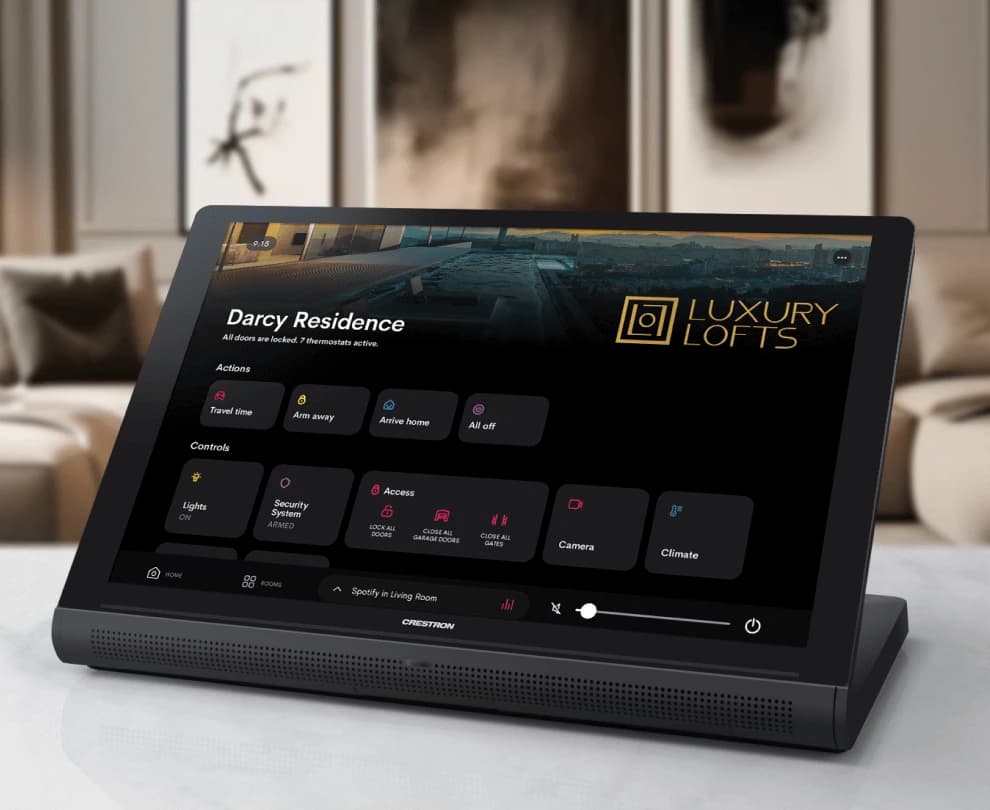
A Crestron Home touch screen on a marble surface in a living room, showing the home view: the residence name, one-touch actions for arriving and leaving, and controls for lights, security, access, cameras and climate
On this page+

Crestron Home is a smart-home platform that puts a property's lighting, blinds and curtains, heating and cooling, music, television, door entry and security under one system, operated from an app, wall touch screens, keypads and remotes. AVC Integrations is a Certified Crestron Integrated Partner and designs, installs, programmes and commissions complete Crestron Home systems for new-build and refurbishment projects across prime Central London.

Written by the AVC project team · Reviewed by Zvonko Rosic, Director, AVC Integrations Ltd

Start here

What Crestron Home actually is

Most beautiful houses are quietly at war with themselves. The lighting is on one system, the blinds on another, the heating has its own thermostat, the television came with three remotes, and the front-door camera lives in an app nobody can find. Every one of those products works. Together, they are a nuisance.

Crestron Home is the layer that sits above all of it. Rather than adding a tenth app, it takes the nine you already have and puts them behind one interface, so the house can be asked to do sensible things: we are going out, we are watching a film, everyone is going to bed, instead of being operated one product at a time.

The technology is genuinely serious; Crestron has been building control systems for commercial and residential buildings for decades. But the measure of a good installation is not the specification. It is that after a fortnight, nobody in the household thinks about it at all.

The short version

  • One app, one set of keypads, one system, instead of a drawer of remotes.
  • Scales from a lateral apartment to a townhouse over six floors.
  • Controls are chosen to suit the interior, not imposed on it.
  • Best decided during design, while the drawings are still moving.
  • Integrates most of what you already own rather than replacing it.
  • Supported and adjusted remotely once you have moved in.

The seven jobs

What it looks after

A Crestron Home system is usually asked to handle some or all of the following. Very few projects take everything at once: most begin with lighting, shading and music, and grow.

01

Lighting

One keypad instead of eight switches.

Dimming, scenes and schedules across the whole property, with keypads chosen to suit the joinery rather than fight it. Lights can follow the clock, the sunrise or a movement sensor, and a single Goodnight press can turn the house off behind you.
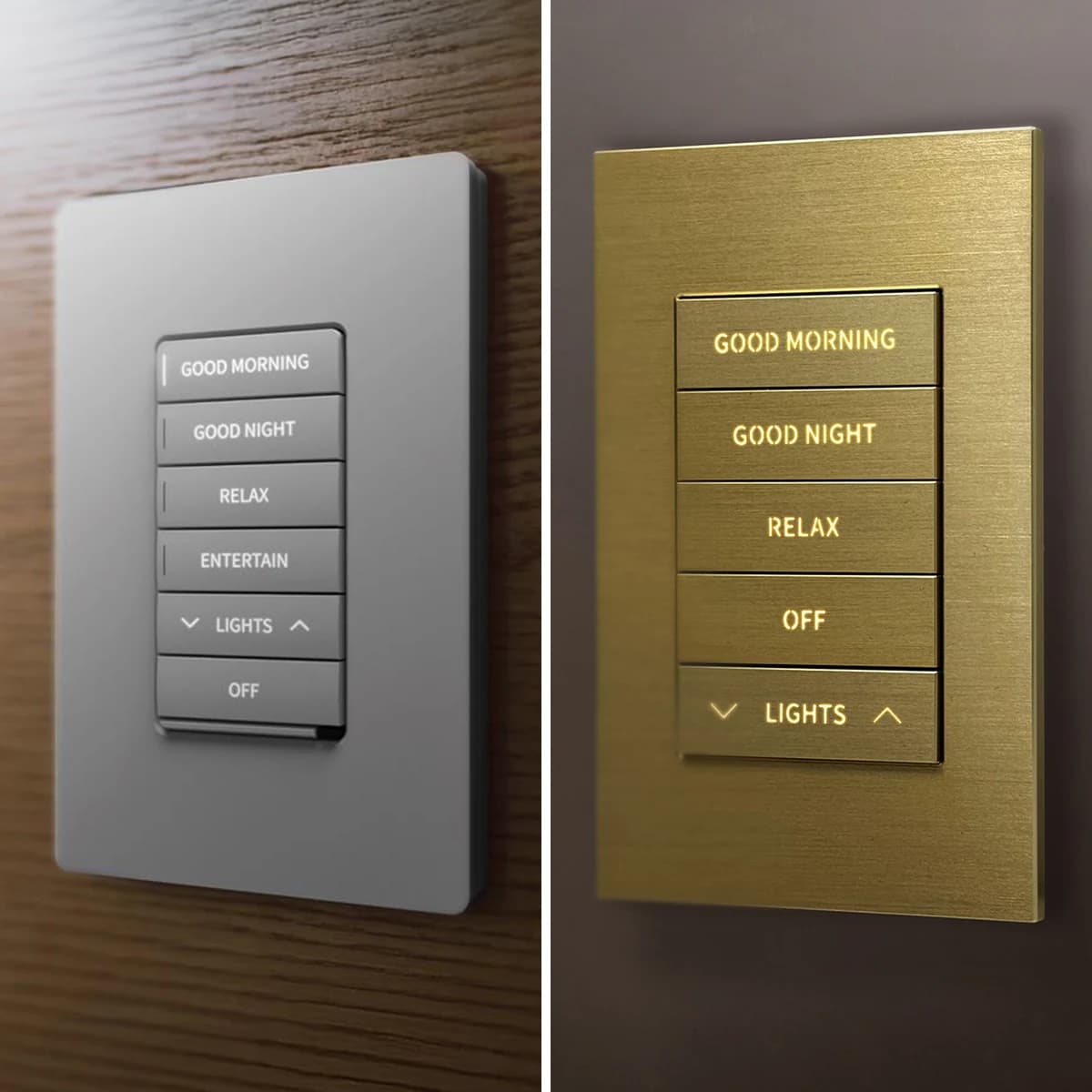
Two Crestron keypads side by side, one in brushed silver on a walnut wall and one in brushed brass, each engraved Good Morning, Good Night, Relax and Lights

02

Blinds & curtains

Light handled as one idea.

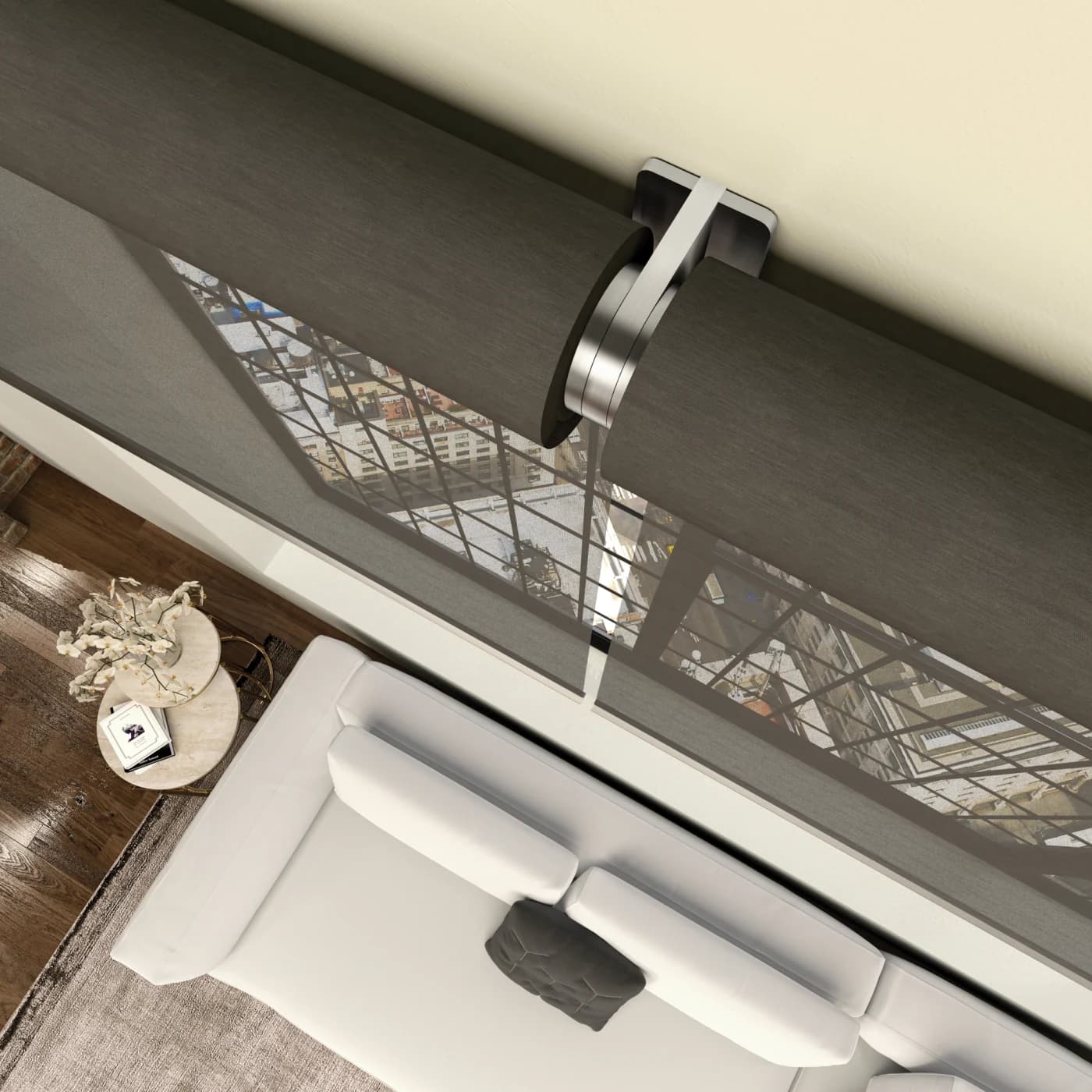
Roller blinds, sheers, Roman blinds and drapery on quiet motors, in a very wide choice of fabrics, moving with the lighting rather than separately from it. Wired for new build and refurbishment; wireless where the fabric of the building will not allow cables.

A motorised roller blind part-lowered across a floor-to-ceiling window, its quiet motor and bracket visible at the head, with a city view beyond

03

Heating & cooling

Comfort you stop thinking about.

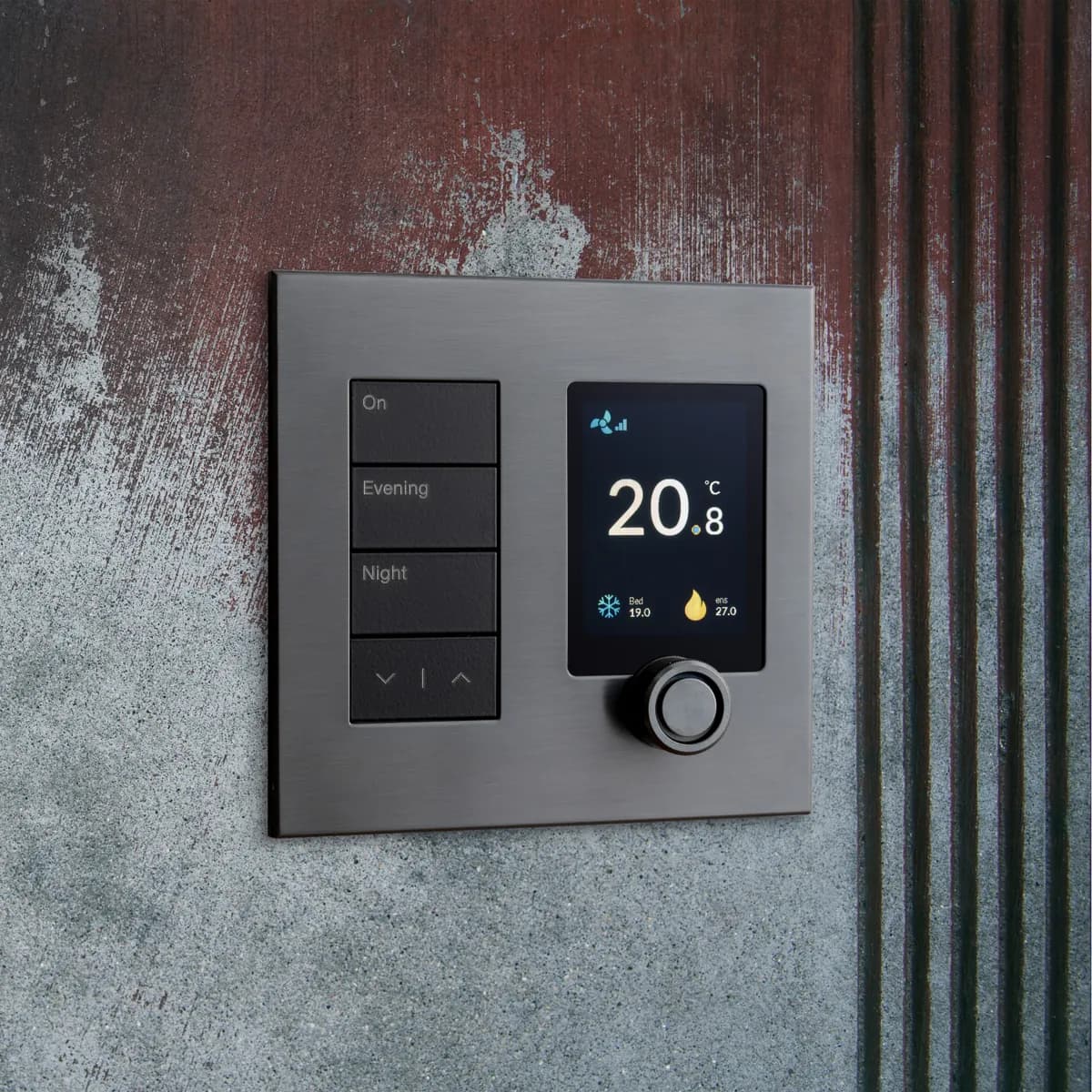
Room-by-room temperature through the same interfaces as everything else, so the house is warm in the rooms being used and quietly economical everywhere else.

A brushed stainless Crestron climate panel set into a wall, showing 20.8°C with On, Evening and Night buttons and a control dial

04

Music

Any room, any music, no clutter.

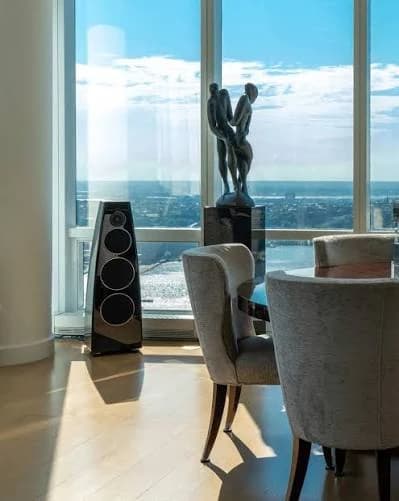
Multi-room audio indoors and out, streaming services and existing kit such as Sonos brought into the same app, with speakers that can sit discreetly in the ceiling or make a proper feature of a listening room.

A floorstanding loudspeaker beside floor-to-ceiling glass in a high-rise dining room, positioned discreetly against the window

05

Television & film

One remote. Actually one.

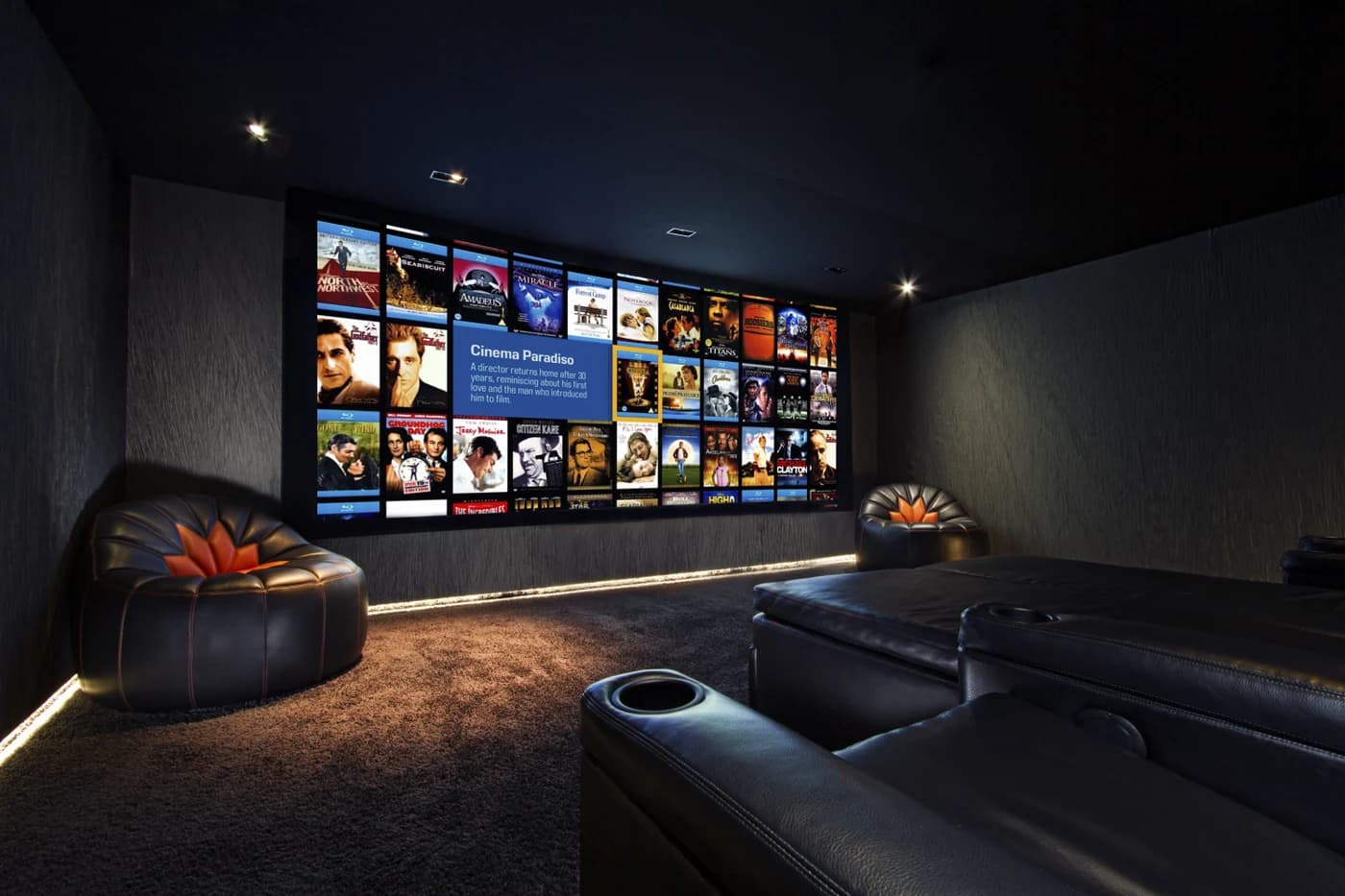
Sources shared around the house over Crestron's DigitalMedia platform, so the boxes live in a cupboard and every screen can reach them. No stack of remotes on the coffee table, no hunting for the right input.

A home cinema room with a large screen showing a film library, tiered leather seating and concealed cove lighting along the walls

06

Doors & security

Know who is at the gate, from anywhere.

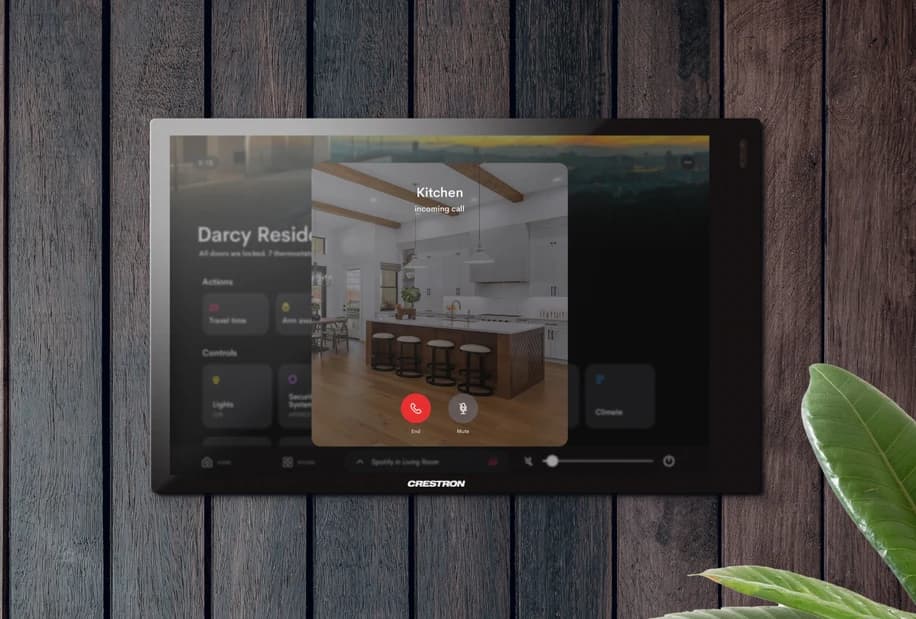
Video door stations, smart locks, gates, garage doors, alarm and cameras presented together on the touch screens and in the app, whether you are in the kitchen or in another country.

A Crestron touch panel mounted on a dark timber wall showing an incoming call from the kitchen door station, with answer and mute controls

07

Everything else

The awkward things, absorbed.

Irrigation, a wine room, a lift, a weather station, specialist kitchen equipment, if it can be controlled, it can usually be brought in rather than left as another orphan app on your phone.

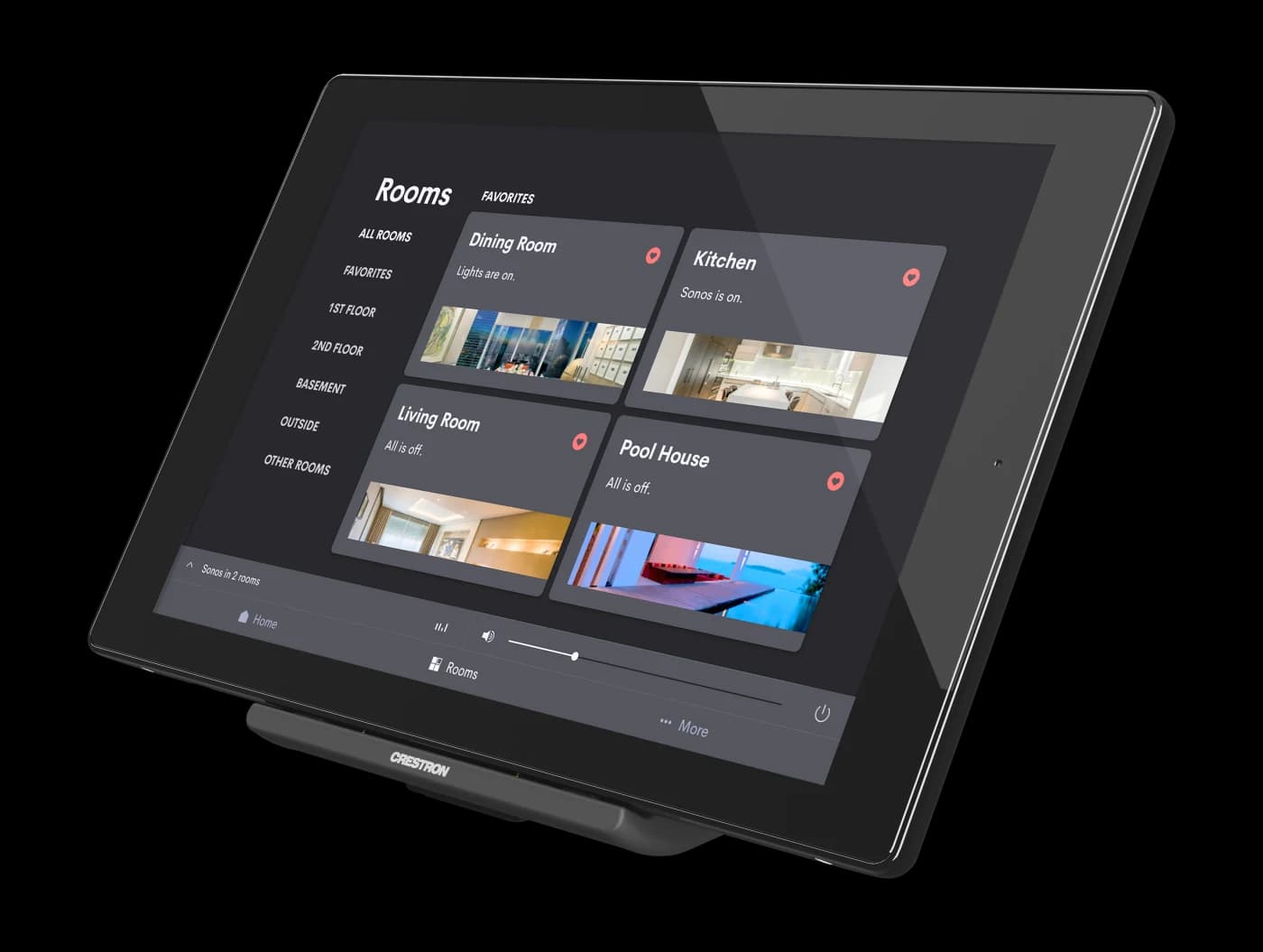
A Crestron tablet on a desk stand showing the Rooms view, each room reporting whether its lights and music are on

In the hand, on the wall

How you actually use it

A good system offers several ways to do the same thing, because a household is not one person. Guests need something obvious. Children need something forgiving. You need something quick.

01

Keypads

The everyday control, and usually the only one you see.

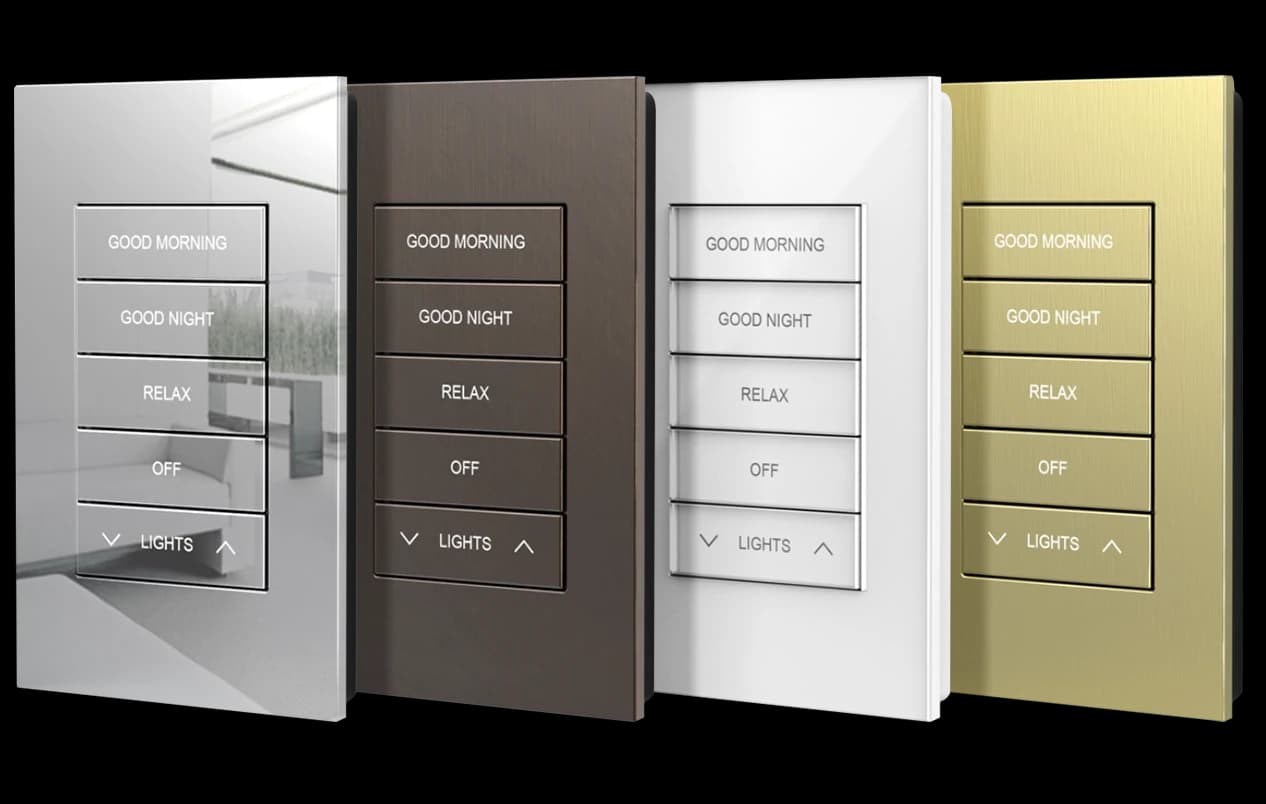
A keypad is a small panel of buttons where a bank of light switches would otherwise be, except each button runs a whole scene and says so in engraved text, so nobody guesses. They come in chrome, bronze, brass, glass, stone and more, specified with your interior designer from samples alongside the ironmongery. The wording is yours: Good Morning, Relax, Goodnight, or whatever the household actually says. Most people use these ninety per cent of the time.

Four Crestron keypads in different finishes: polished chrome, brushed bronze, gloss white and brushed brass: each engraved Good Morning, Good Night, Relax, Off and Lights

02

Touch screens

One interface, everywhere.

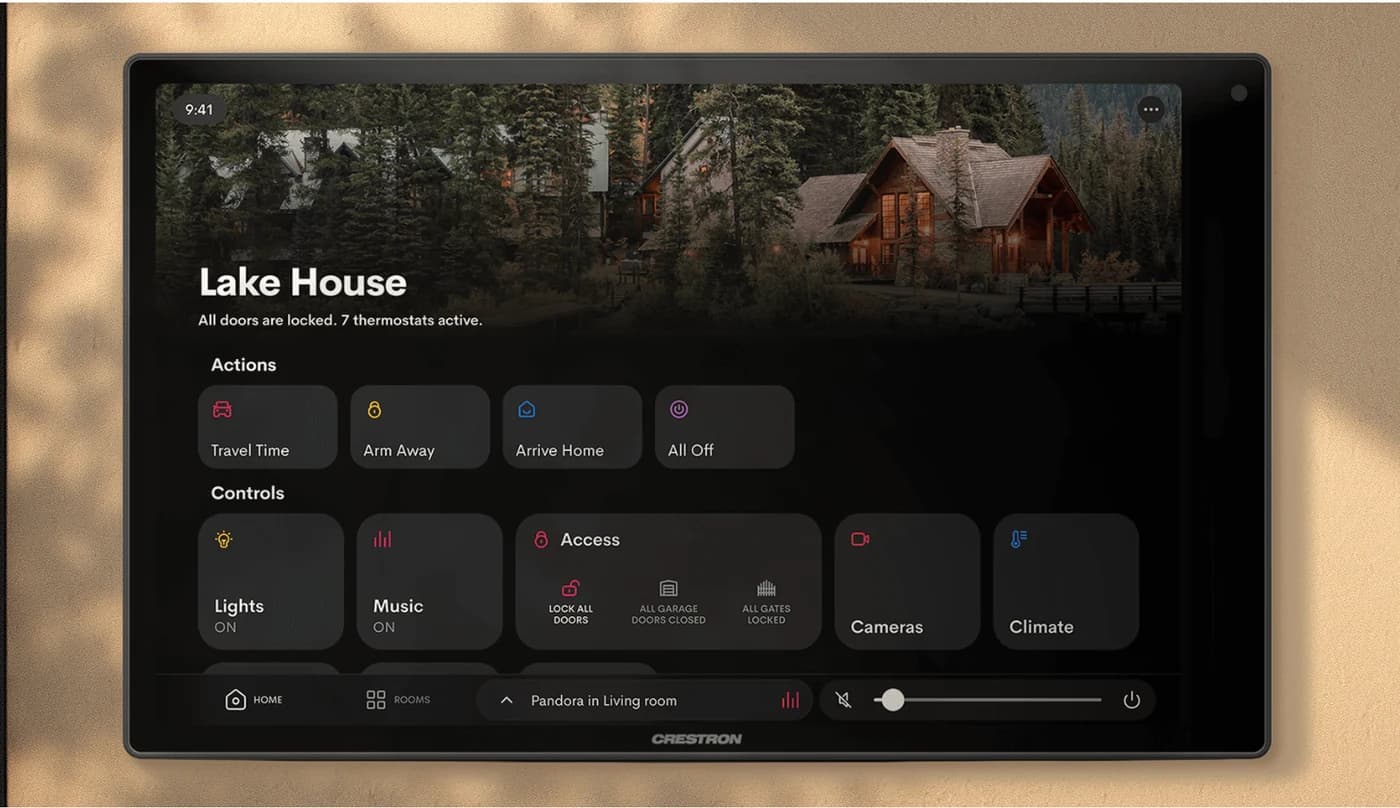
Wall-mounted or on a table, in 5, 7 and 10 inch sizes. This is the part that separates a real system from a drawer of gadgets: every screen in the house shows the same thing laid out the same way, and so does the app in your pocket. The house is presented room by room in plain words, each room saying what it is currently doing, lights are on, shades are open, so you see the whole property at a glance instead of opening six apps. A house that needs explaining is a house nobody uses properly; this one can be handed to a guest or a housekeeper without a tutorial.

A wall-mounted Crestron touch screen showing the home view for a property, with one-touch actions for arriving and leaving above controls for lights, music, access, cameras and climate

03

The app

The same house, from anywhere.

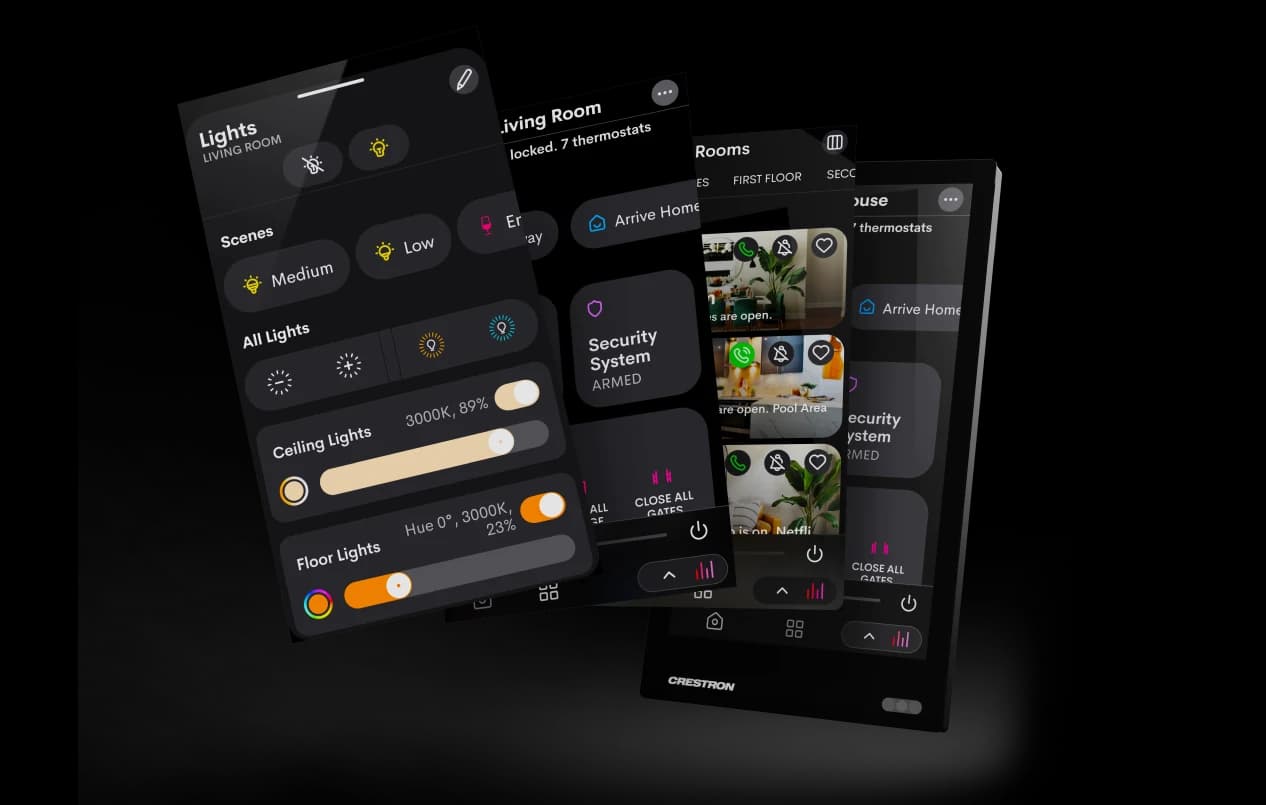
On iOS and Android, and the same interface whether you are upstairs or in another time zone. Check the alarm from a plane, let a housekeeper in, start the heating before you land. Scenes, dimming, blinds, cameras and door locks all sit behind the same few taps they do on the wall; there is nothing new to learn because there is nothing different to learn.

Three phone screens from the Crestron Home app, showing lighting scenes with colour temperature and brightness sliders, a room overview with the security system armed, and a rooms list with camera previews

04

Handheld remotes

For the rooms where people just want a button.

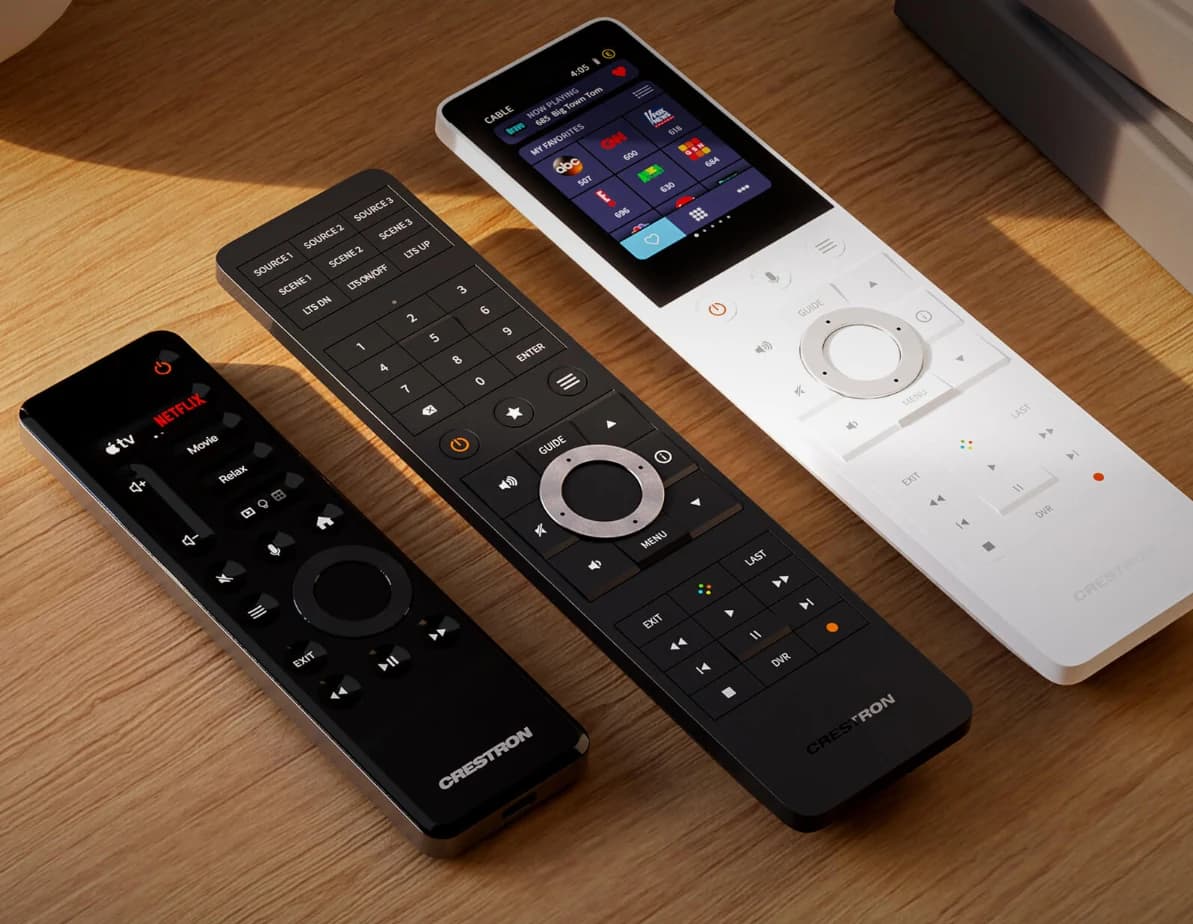
Television is the one place a phone is a nuisance; the film has already started and nobody wants to unlock a screen. These are engraved and backlit, with a colour display for choosing what to watch and real buttons underneath for volume, channels and playback: the things you want to find in the dark without looking down. In black or white, to suit the room.

Three Crestron handheld remotes lying on a wooden surface, two black and one white, one with a colour touch screen showing television favourites, the others with engraved scene and source buttons

And the one feature everybody ends up loving

Crestron calls them Quick Actions; you will call them the good night button. One press: lights down, blinds closed, televisions off, heating set back, alarm armed, doors locked. It is a small thing that quietly removes a five-minute ritual from every single evening.

What it feels like

A day in a Belgravia house

Specifications are hard to imagine. Days are easy. Here is an ordinary Tuesday in a house running a well-designed system, nothing exotic, just the building paying attention.

  1. 6.40 am

    The house wakes before you do

    In the principal bedroom the light comes up over twenty minutes and the blinds ease open behind it, so you surface in daylight rather than to an alarm. Downstairs the kitchen is already warm; the rest of the house is not, because nobody is in it.

  2. 8.15 am

    Everybody leaves

    One press by the front door. Lights off, music off, heating set back, alarm armed. The blinds on the south side drop halfway on a bright morning, which is the difference between a drawing room that is comfortable at six and one that has been baking all day.

  3. 11.30 am

    A delivery arrives

    The door station rings your phone rather than an empty hall. You see who it is, speak to them, and unlock the porch, from a desk in the City, or from Zurich. Nothing about this requires being at home.

  4. 4.00 pm

    The light changes and so does the house

    London in winter goes dark at half past three. Rather than a house that stays gloomy until somebody notices, the lighting lifts gently as daylight falls away, tracking the actual sun rather than a fixed timer.

  5. 8.00 pm

    Dinner, then a film

    One button in the dining room: pendants down, art lighting up, music on at a level that lets people talk. Later, in the snug, another button: screen down, blinds closed, lamps to a low wash. No hunting for the right input. No three remotes.

  6. 11.20 pm

    Goodnight

    One press by the bed. The house closes itself: downstairs lights out, blinds down, alarm on, doors locked, hallway lights left at five per cent so nobody navigates the stairs by phone torch.

Not one of those moments is dramatic. That is rather the point; the best compliment a system of this kind receives is that guests never notice it, and the household forgets it was ever installed.

The part people underestimate

Light, and how a house makes you feel

Britain gives you roughly eight hours of daylight in December and sixteen in June. A house that ignores that is working against its occupants for half the year, and in a city of tall buildings, north-facing rooms and narrow light wells, the problem is sharper than the latitude alone suggests.

Tunable lighting lets the colour of the light shift through the day: cooler and brighter in the morning when you want to be alert, warmer and lower in the evening when you do not. Paired with automated blinds and a daylight sensor, the house borrows real daylight where it can and supplies the rest, so a basement kitchen in Chelsea can feel far less like a basement.

Crestron makes claims about sleep, mood and concentration. We would put it more plainly: rooms lit like this are simply more pleasant to be in, and people stay in them longer.

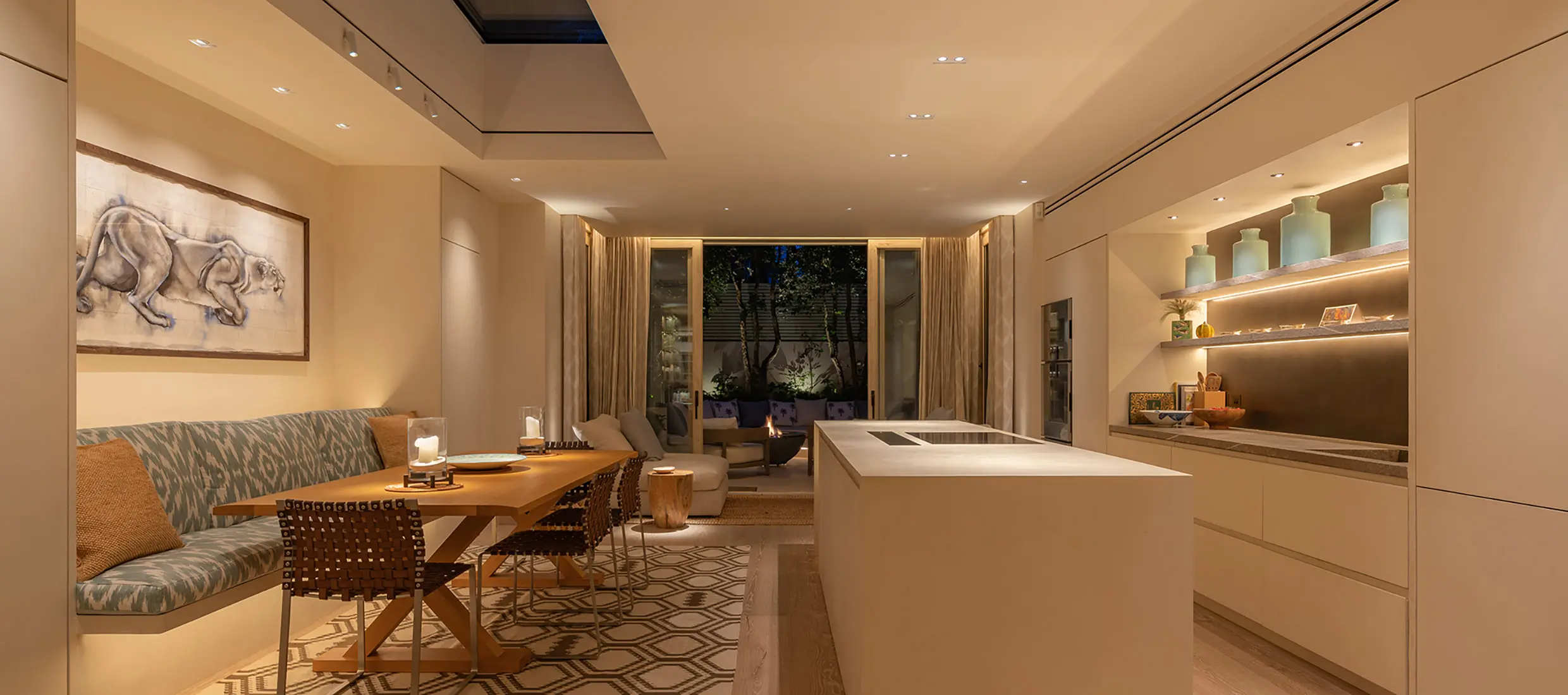
A London kitchen and dining room in the evening: a lit artwork above a banquette, candles on the dining table, concealed cove lighting, lit open shelving, downlights over the island, and the planted garden lit beyond the glass doors
Every layer described above, in one room: the artwork lit, the shelving lit from within, a cove washing the ceiling, discreet downlights over the island, candles on the table, and the garden lit beyond the glass, so the room does not end at the window after dark.

For the design team

Architects and interior designers

You have spent months on the plasterwork, the joinery and the ironmongery. The fastest way to spoil it is to let a control system arrive late and start asking for wall space. Involved early, it does the opposite, it removes clutter from your elevations.

Fewer things on the wall

One keypad replaces a bank of switches and dimmers. On a typical prime project this removes a great many plates from the elevations, which is usually the first thing designers notice.

Finishes you choose, not inherit

Several keypad families in a wide range of materials and finishes, with engraved text. Specified alongside the ironmongery, from physical samples, before anything is ordered.

Coordinated on the drawings

We mark control positions, back boxes, containment and equipment space on the plans, so what is agreed in design is what appears on site.

Somewhere for the equipment to live

Every system needs a cupboard with power, ventilation and access. Identified at design stage it is unremarkable; found at second fix it comes out of somebody's wardrobe.

Shading as part of the interior

Several hundred fabrics across rollers, sheers, Romans and drapery, chosen with your scheme, on motors quiet enough not to interrupt a conversation.

Lighting design protected

If a lighting designer is appointed, we implement their intent rather than dilute it: the scenes, the layering and the dimming curves are theirs, executed properly.

For the delivery team

Project managers and main contractors

What you need from a control contractor is not enthusiasm. It is drawings on time, a single point of responsibility, and no surprises at second fix.

When AVC input is needed at each project stage
StageWhat we needWhat you get
ConceptPlans, the brief, an idea of ambitionBudget range and a system strategy
Detailed designArchitectural, M&E and lighting drawingsLayouts, schedules, equipment space and load
TenderSpecification and programmePriced, itemised scope
Before first fixAccess and the electrical programmeContainment, back boxes, cable routes
Second fixFinished surfaces, decoratedDevices fitted, tested, nothing chased
CommissioningA quiet building, near completionScenes tuned, household trained, handover pack

On most of our projects AVC also delivers the electrical installation. That matters more than it sounds: the control scope arrives already coordinated with its power, containment and lighting circuits, and there is nobody to blame at the interface between two trades, because there is no interface.

An honest answer

Crestron, Lutron or Control4?

We design and install all three, which means we have no reason to sell you the wrong one. We settle the architecture first; what is controlled, from where, by whom, and choose the platform second.

Crestron Home

Strength
Breadth and depth. It will absorb almost anything in the building and present it as one system, and it scales to very large properties without straining.
Suits
Whole-house projects where audio, video, lighting, climate, access and security should behave as a single thing, and where the client wants one app that genuinely does everything.

Lutron HomeWorks

Strength
The finest lighting and shading control available, with the widest choice of keypad finishes.
Suits
Projects where light is the point. Frequently specified alongside Crestron, with Lutron running lighting and shading and Crestron coordinating the rest.

Control4

Strength
Capable whole-home control at a gentler budget.
Suits
Apartments and smaller houses where the ambition is real but the scope is tighter.

A great many of our projects run both Crestron and Lutron: Lutron on lighting and shading, Crestron coordinating everything else, presented to the household as one system. If that sounds like an expensive compromise, it is usually the opposite: each platform does what it is best at. We have written about whether you actually need both, and our Lutron lighting page covers that side in the same detail.

Where the theory meets the building

London realities

Prime Central London is not a straightforward place to install anything. The buildings are old, protected, shared, and frequently all three at once. These are the constraints we design around every week.

Listed buildings

Much of Mayfair, Belgravia and Marylebone is listed. Chasing walls and lifting original floors may not be permitted. We design around it, wireless controls where cabling is impossible, existing voids and service routes used intelligently, and proposals put to the conservation officer with the design team rather than after the fact.

Mansion blocks & shared freeholds

Kensington and Chelsea are full of them. Works are governed by the lease, the managing agent and the neighbours: restricted hours, no penetration of party walls, goods lifts booked in advance. We plan the installation around those rules instead of discovering them mid-programme.

Conservation areas

External work, an aerial, a satellite dish, a gate intercom, a camera, attracts scrutiny even where the interior does not. We keep external hardware minimal and discreet, and specify what is likely to be acceptable.

Lateral apartments

Wide, shallow, and often with only one aspect. Ceiling voids are shallow and there is rarely a plant room. The equipment strategy has to be lean, quiet and well ventilated, because it is going in a cupboard next to somewhere people sleep.

Townhouses over five or six floors

Long cable runs, several risers and a lift to think about. The advantage is space for a proper equipment room; the discipline is planning the vertical routes before anyone boards the risers.

Riverside and new-build

Nine Elms, Battersea and Chelsea Harbour bring large glazing, real solar gain and developer-fit-out constraints. Automated shading stops being a luxury and starts being how the flat remains habitable in July.

From drawing to handover

How we deliver it

  1. 01

    Understand the household

    How the family actually lives, room by room. Who needs what, where, and how much they want to think about it. Brands do not come up in this conversation.

  2. 02

    Design the architecture

    What is controlled and what is merely interfaced; where controls sit; what the cabling must reach; how big the cupboard needs to be. This is the work that determines whether the finished system is any good.

  3. 03

    Specify the platform

    Only now. Crestron Home, Lutron, Control4 or a combination, chosen against the brief and the budget, with the reasoning written down.

  4. 04

    Coordinate and document

    Drawings, schedules and equipment lists issued to the architect, M&E consultant and contractor, so first fix happens once and correctly.

  5. 05

    Install and programme

    Containment and cabling before the walls close; devices at second fix onto finished surfaces; programming built and tested off site wherever possible.

  6. 06

    Commission, tune, hand over

    Scenes set with you in the actual rooms at the actual times of day: evening scenes judged in the evening. Then a proper demonstration, documentation, and ongoing remote support.

Design, not just installation

We can design the lighting and shading too

Most integrators install what somebody else has drawn. We can do the drawing as well, the full lighting and shading design, from the first reflected ceiling plan through to the scenes tuned on the last evening before handover.

A single bright fitting in the middle of the ceiling flattens a beautiful room. Good lighting is layered: several kinds of light doing different jobs, so one room can be a working kitchen at eight in the morning and somewhere you want to sit at nine at night.

Ambient

The soft, even wash that makes a room usable. It should be felt rather than noticed; you should never be able to point at where it comes from.

Task

Light where something is actually done: worktops, a reading chair, a desk, the mirror. Aimed properly, so nobody works in their own shadow.

Accent

Art, sculpture, a fireplace, the good joinery. The things you spent money on, given a reason to be looked at.

Architectural

Light built into the fabric: coves and slots, under-shelf and joinery lighting, stair and step lighting, grazed stone and panelling, the garden read through the glass after dark. No visible fittings at all, just the building lit.

Decorative

Chandeliers, pendants, table and floor lamps. Chosen with your interior designer as furniture, then dimmed to sit inside the scheme rather than fight it.

Daylight, and shading

Designed at the same time as the rest, because it is the same problem. Blinds and curtains that manage glare and heat in July and privacy in January, moving with the lighting rather than against it.

Why doing both together costs you less

Lighting design and lighting control are usually bought from two different companies, and the gap between them is where money quietly disappears. The designer draws the fittings; the control contractor arrives later and finds the circuits split the wrong way for the scenes the drawing implies. Somebody pays to put it right, and it is rarely the person who caused it.

  • One team draws the light and wires it, so the circuits match the scenes by design rather than by luck.
  • The Crestron system is specified around the lighting design, not retro-fitted to it afterwards.
  • No second set of fees for coordinating two suppliers who each think the other has it covered.
  • Errors are caught on the drawing, where they cost an hour, not on site, where they cost a wall.
  • Fewer variations during construction, the expensive kind that arrive after first fix.
  • One number to call when something is not right, and nobody to blame but us.

Because it all sits on Crestron Home, the finished house does what the design intended: the layers combine into scenes, the blinds move with them, and the household presses one button rather than learning a system. That compatibility is the whole point; the design and the control were never two separate things to begin with.

The part nobody sees

How it is installed matters as much as what is installed

Every system in this business is bought from the same manufacturers. What separates a good installation from a bad one is almost entirely the work hidden in a cupboard, and it is the difference between a fault taking twenty minutes to fix and taking a day.

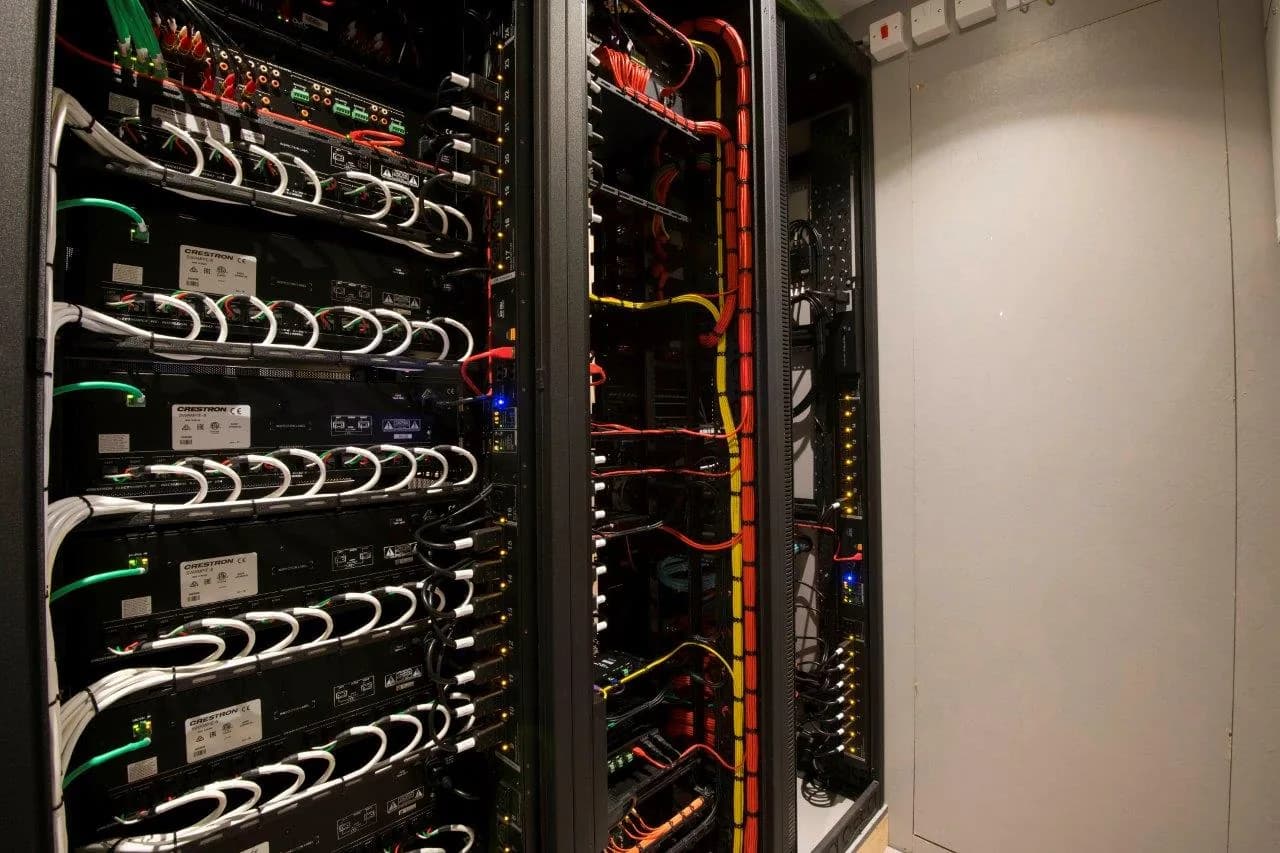
A Crestron equipment rack in a completed AVC project, with processors and amplifiers neatly stacked, every cable dressed, colour-coded and routed through vertical cable management
An AVC equipment rack on a completed project. Every cable dressed, colour-coded and routed, and every one of them labelled at both ends.

This is our standard, and it does not change with the size of the job. A rack in a two-bedroom apartment is built to the same discipline as one in a house over six floors, because the reason for doing it has nothing to do with scale.

Every cable labelled, both ends

Not just at the rack. Find a cable anywhere in the building and it tells you what it is and where it goes, which is how a fault becomes a twenty-minute visit rather than a morning of tracing wires.

Dressed and routed, not bundled

Cables run in proper containment with service loops, so equipment can be pulled forward and worked on without disturbing anything either side of it.

Room to breathe, and to grow

Racks are ventilated, powered and protected properly, with space left deliberately. Adding a room, a screen or a service in three years should not mean rebuilding the cupboard.

Tested before it is closed

Cabling is tested and results recorded before walls and floors go back. A cable that fails after the plastering is finished is an expensive problem that should have been found earlier.

As-built documentation, handed over

Drawings that reflect what was actually installed rather than what was drawn a year earlier, with schedules, labelling schemes and configuration. You own it; it is not held hostage by the contractor who fitted it.

Anyone can pick it up

The real test: an engineer who has never seen the property should be able to open the cupboard, read the labels and the drawings, and understand the system without ringing us. That is the standard we build to.

None of this is glamorous and none of it is visible in a finished room. It is, however, what you are actually buying, and it is the reason a system is still straightforward to maintain long after the people who installed it have moved on.

Why us

Why AVC

Certified Crestron Integrated Partner

Crestron-accredited, and equally at home specifying Lutron and Control4, so the recommendation follows the project rather than a single supplier relationship.

One company, one responsibility

We design and deliver the electrical installation as well as the control system on most projects. When something needs resolving there is one number to call, not a negotiation between trades.

Engineers, not box-shifters

We are an MEP engineering practice that also does smart homes, rather than an AV retailer that has learned some wiring. The system is designed to the building, and the building is designed around it.

Used to the professional team

Architects, interior designers, lighting designers, M&E consultants, project managers and main contractors; we work inside that structure constantly and produce the information it needs.

Where we work

Central London project areas

AVC undertakes Crestron Home projects throughout prime Central London. Much of our work is concentrated in:

MayfairBelgraviaKnightsbridgeChelseaKensingtonSouth KensingtonMaryleboneSt James's

We also take on projects in Holland Park, Notting Hill, Bayswater, Westminster, Pimlico, Victoria, Fitzrovia, Covent Garden, Soho, Bloomsbury, Regent's Park, St John's Wood, Maida Vale, Hampstead, Highgate, Fulham, Parsons Green, Chelsea Harbour, Battersea, Nine Elms, Canary Wharf and The City of London. These are areas where we undertake projects; our office is in Croydon, and we work across London and the South East.

Questions, answered

Frequently asked questions

What is Crestron Home?+

Crestron Home is a smart-home platform that brings a property's separate systems: lighting, blinds and curtains, heating and cooling, music, television, door entry and security: under one operating system, controlled from an app, wall-mounted touch screens, keypads and handheld remotes. Instead of a different app for every product, the household gets one coherent system.

Is Crestron only for very large houses?+

No. The platform scales, and we specify it for lateral apartments and penthouses as often as for townhouses. What matters is the ambition of the brief rather than the floor area: a two-bedroom apartment where lighting, shading, music, climate and door entry should all behave as one system is a perfectly sensible Crestron project.

Is AVC a Crestron partner?+

Yes. AVC Integrations is a Certified Crestron Integrated Partner. We also design and install Lutron and Control4 systems, which is deliberate; it means we can recommend the platform that suits your project rather than the only one we are able to sell.

When should Crestron be considered in a project?+

During design, while drawings are still being developed. Control systems shape electrical circuits, cable routes, keypad positions, ceiling details and the size of the equipment cupboard. Decided early, these things are inexpensive. Decided after first fix, they mean opening finished walls.

What happens if we involve you after first fix?+

It is not fatal, but it narrows the options and raises the cost. Wireless products and surface containment can rescue a good deal, and we are candid about what can and cannot be achieved once the walls are closed. We would always rather tell you the constraints honestly than promise a result the building will not allow.

Will the controls suit our interior design?+

That is largely the point. Keypads come in several families and a wide range of finishes and materials, with engraved button text, so they are selected alongside ironmongery and switch plates rather than accepted as standard white plastic. We put samples in front of the interior designer before anything is ordered.

How many touch screens and keypads will we need?+

Fewer than most people expect. A well-designed system uses a small number of well-placed controls: one considered keypad by the door usually replaces a bank of switches. We design the control positions on the plans with your architect and interior designer so the walls stay calm.

Can Crestron control the blinds and curtains too?+

Yes. Crestron makes its own motorised shading: roller blinds, sheers, Roman blinds and drapery, on notably quiet motors, with several hundred fabrics to choose from. Because the shading and the lighting are on the same system, natural and electric light can be handled as one idea rather than two.

Can it work with the systems we already have?+

Usually, yes. Crestron Home integrates a great many third-party products, Sonos, smart locks, video door stations, alarm systems and more. Part of our design work is establishing what is worth integrating properly, what is better replaced, and what should simply be left alone.

What does a Crestron Home system cost in London?+

It depends on the property, the number of lighting circuits, how much automated shading is involved, how many rooms take music and video, and how much of the wider house is integrated. We price each project from its drawings and specification rather than quoting packages, so the figure reflects your building rather than an average.

Can AVC design the lighting as well as install it?+

Yes. We offer full lighting and shading design as well as the control system: reflected ceiling plans, fitting selection, circuit design, architectural detailing and the scenes themselves. Most integrators only install what someone else has drawn; because we do both, the circuits are designed around the scenes from the start rather than corrected once the walls are closed.

Does designing the lighting and the control together save money?+

Usually, yes. When lighting design and lighting control are bought from two companies, the gap between them is where cost appears: circuits split the wrong way for the intended scenes, coordination fees on both sides, and variations raised after first fix. One team drawing the light and wiring it removes that gap: mistakes get caught on the drawing, where they cost an hour, rather than on site, where they cost a wall.

What is layered lighting?+

Using several kinds of light for different jobs rather than one bright fitting in the middle of the ceiling. Ambient light makes a room usable, task light serves worktops and reading chairs, accent light picks out art and joinery, architectural light is built into coves, stairs and panelling, and decorative fittings do the rest. Layered properly, one room can be a working kitchen in the morning and somewhere you want to sit at night, which is exactly what a control system then turns into scenes.

Do you work with architects, interior designers and project managers?+

Constantly, and it is how we prefer to work. We coordinate with the architect, interior designer, lighting designer, M&E consultant and main contractor from design stage, issue the drawings and schedules the contractor needs, and treat the design intent as something to protect rather than a complication.

Can Crestron be installed in a listed building or conservation area?+

Frequently, yes, much of prime Central London is listed or in a conservation area, and we work in these buildings regularly. It calls for a lighter touch: wireless products where chasing is not permitted, careful routing through existing voids, and control positions agreed with the conservation officer and the design team rather than assumed.

Who looks after the system once we move in?+

We do. Handover includes a proper demonstration for the household and, where relevant, for staff, along with documentation. Systems can be supported and adjusted remotely, so a change of routine or a new television does not require anyone to open a wall.

Which parts of London do you cover?+

We undertake projects across prime Central London, much of our work is in Mayfair, Belgravia, Knightsbridge, Chelsea and Kensington, and throughout the wider capital from Hampstead to Canary Wharf. Our office is in Croydon and we work across London and the South East.

Start the conversation

Involve AVC in your project

If you are planning a new-build home, an apartment or a major refurbishment in Central London, the moment to talk is while the drawings are still live. Send your architectural plans, electrical or lighting drawings, interior information, programme or current specification, and our project team will come back to you with a considered view, including an honest one about whether Crestron is the right platform for what you are doing.

Drawings or specification (optional)

Up to 4 MB, for larger drawing sets, send this form and email the files to info@avc-uk.com. Files are sent securely with your enquiry to our project team and are not published anywhere.

AVC designs and delivers complete Crestron Home systems for new-build and major refurbishment projects, alongside your architect, interior designer and contractor.